
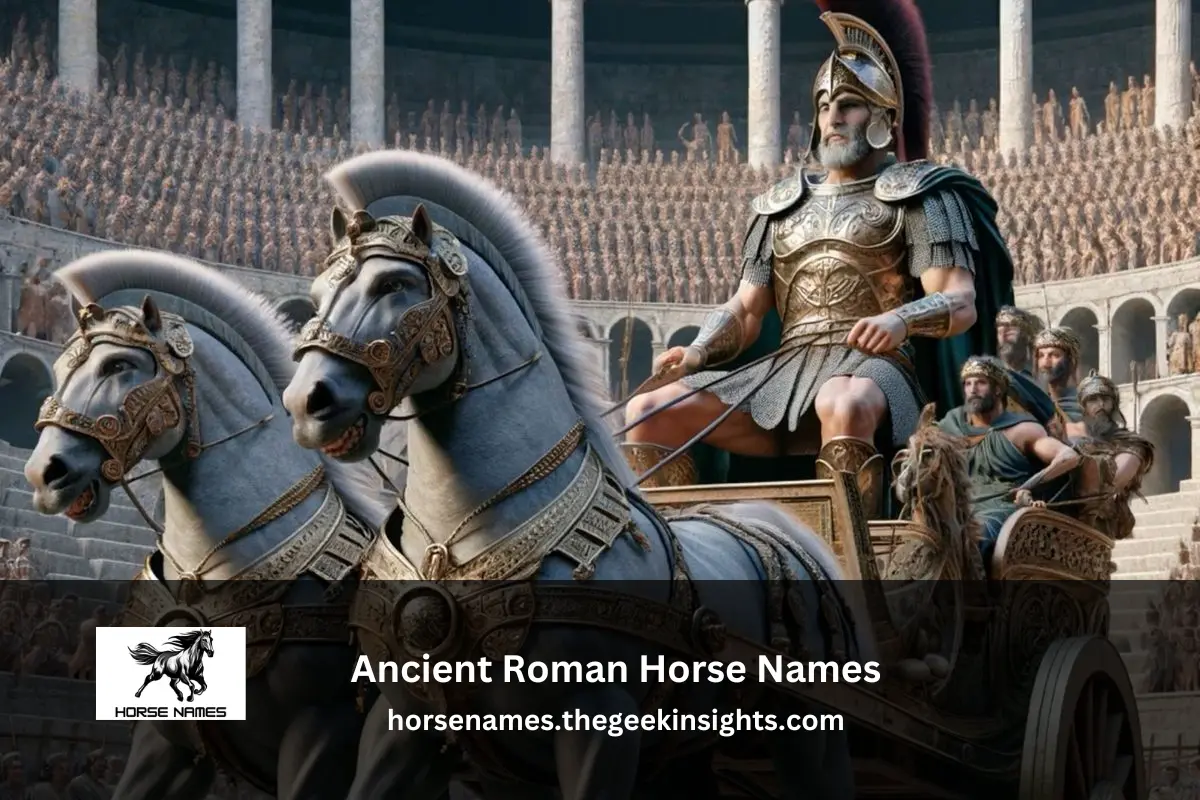
Ancient Roman Horse Names
Here’s a strong and richly cultural selection of Ancient Roman Horse Names, taken from Roman gods, emperors, military ranks, virtues, and Latin words. These are perfect for horses that exude strength, grace, and authority, ideal for dressage, ceremonial purposes, or historically themed characters.
Ancient Roman horses were at the very heart of war, travel, and public spectacle. Their names, reflecting status and discipline, were often infused with myth, honor, and martial distinction. For your noble steed, your show horse, or your game companion, these names evoke classical refinement and imperial gravity.
Here are Top 10 Ancient Roman Horse Name Ideas for all the major horse types (or proto-breeds) of the Roman world, drawn from Roman virtues, mythology, great generals, and Latin sayings.
These names capture the majesty, vigor, and decorum of the Roman Empire, great for horses with dignified bearing or for their owners who love classical antiquity.
Imperial & Noble Roman Horse Names
| Name | Meaning / Inspiration |
|---|---|
| Caesar | Title of Roman emperors |
| Aurelius | Golden / name of Marcus Aurelius |
| Octavian | Augustus Caesar’s birth name |
| Domitia | Noble Roman woman |
| Severus | Serious / strict / emperor |
| Flavia | Golden-haired (feminine) |
| Maximus | Greatest |
| Claudia | Noble Roman family name |
| Tiberius | Emperor / name of river Tiber |
| Cornelia | One of Rome’s most famous matrons |
Military-Inspired Names
| Name | Meaning / Inspiration |
|---|---|
| Legatus | General / high-ranking officer |
| Centurion | Roman army commander |
| Gladius | Short Roman sword |
| Vexilla | Battle standard / banner |
| Praetor | Military magistrate |
| Cohortia | A play on “cohort” (unit of soldiers) |
| Scutum | Roman shield |
| Pilus | Spear used by legionaries |
| Tribuna | Female take on “tribune” |
| Lancerus | Spearman |
Latin Virtue Names (Unisex)
| Name | Meaning in Latin |
|---|---|
| Virtus | Courage / virtue |
| Fidelis | Loyal / faithful |
| Fortuna | Fortune / luck |
| Gloria | Glory |
| Pax | Peace |
| Honoratus | Honored |
| Nobilis | Noble |
| Veritas | Truth |
| Tempestus | Stormy / tempest |
| Justa | Justice / fairness (feminine) |
Famous Roman Horse & Chariot References
| Name | Reference |
|---|---|
| Incitatus | Emperor Caligula’s prized horse |
| Auriga | Charioteer |
| Quadriga | Four-horse chariot |
| Albus | “White” in Latin |
| Currus | Chariot |
| Victorinus | Little conqueror |
| Celer | Swift |
| Spina | Central barrier of the circus |
| Circus Maxima | Inspired by Circus Maximus |
| Velox | Speedy / fast |
Names Inspired by Roman Emperors & Generals
| Name | Reference / Meaning |
|---|---|
| Caesar | Title of Roman rulers (Julius Caesar) |
| Augustus | “The Revered One” – first emperor |
| Hadrian | Emperor who built Hadrian’s Wall |
| Nero | Known for flair and drama |
| Trajan | Powerful military leader and emperor |
| Cicero | Statesman and orator |
| Brutus | Symbol of rebellion |
| Scipio | Victor of Hannibal, strategic genius |
| Tiberius | Second Roman emperor |
| Cato | Philosopher and traditionalist warrior |
Latin Virtue-Inspired Horse Names
| Name | Meaning |
|---|---|
| Virtus | Courage, valor |
| Gloria | Glory |
| Fidelis | Faithful |
| Justitia | Justice (feminine) |
| Fortis | Brave, strong |
| Pax | Peace |
| Lux | Light |
| Veritas | Truth |
| Tempestus | Stormy / tempest |
| Aquila | Eagle (symbol of Roman legions) |
Nature & Mythical Latin Names
| Name | Meaning / Symbolism |
|---|---|
| Ignis | Fire |
| Nox | Night |
| Aether | Upper air, pure sky |
| Vespera | Evening star / dusk |
| Terra | Earth |
| Flumen | River |
| Solis | Of the sun |
| Ventus | Wind |
Famous & Poetic Roman-Inspired Horse Names
| Name | Reference |
|---|---|
| Incitatus | Caligula’s famous horse |
| Equinox | Balance of day and night (Latin origin) |
| Marcellus | Noble Roman name |
| Bellator | “Warrior” |
| Cassia | Feminine Roman name |
| Flavia | Golden-haired / noble family line |
| Domina | Lady / noblewoman |
| Magnus | “Great” |
| Crassus | Wealthy Roman general |
Elegant & Classical Names
- Sabina – Noble Roman matron
- Octavia – Name of Augustus’ sister
- Maximus – The greatest
- Aurelia – Golden, refined
- Lucius – Light-bringer
- Tullia – Daughter of Cicero
- Quintus – The fifth-born
- Vibia – From a noble Roman gens
- Vita – Life
- Faustina – Fortunate, blessed
Stallions/Geldings:
Imperial & Noble
- Augustus – “venerable, majestic”
- Caesar – “long-haired” (imperial title)
- Marcus – “warlike”
- Gaius – “rejoice”
- Lucius – “light”
- Quintus – “fifth”
- Maximus – “greatest”
- Magnus – “great”
- Aurelius – “golden”
- Claudius – “lame” (but noble family name)
Military & Conquest
- Victor – “conqueror”
- Triumphus – “triumph”
- Gladius – “sword”
- Centurio – “centurion”
- Legatus – “commander”
- Aquila – “eagle” (legion standard)
- Bellator – “warrior”
- Fortis – “brave, strong”
- Invictus – “unconquered”
- Imperator – “commander”
Mythology
- Hercules – legendary hero
- Atlas – titan who held up sky
- Perseus – Greek hero
Virtues & Qualities
- Felix – “lucky, happy”
- Nobilis – “noble”
- Validus – “strong”
- Celer – “swift”
- Ferox – “fierce”
- Audax – “bold”
- Fidelis – “faithful”
- Pius – “dutiful”
- Severus – “stern”
- Constans – “constant”
Mares:
Empresses & Noble Women
- Augusta – “venerable” (empress title)
- Livia – wife of Augustus
- Julia – “youthful”
- Claudia – from noble family
- Cornelia – “horn”
- Octavia – “eighth”
- Antonia – from Antony family
- Agrippina – imperial name
- Faustina – “fortunate”
- Lucilla – “little light”
Beauty & Grace
- Bella – “beautiful”
- Pulchra – “beautiful”
- Gratia – “grace”
- Charitas – “charity, love”
- Spes – “hope”
- Pax – “peace”
- Gloria – “glory”
- Honoria – “honor”
- Clementia – “mercy”
- Felicitas – “happiness”
Nature & Elements
- Rosa – “rose”
- Stella – “star”
- Alba – “white, dawn”
- Flavia – “golden, blonde”
- Nigra – “black”
- Rufa – “red-haired”
- Aqua – “water”
- Terra – “earth”
- Flamma – “flame”
- Ventus – “wind”
Geographic (Roman Provinces/Cities)
- Roma – “Rome”
- Gallia – “Gaul”
- Hispania – “Spain”
- Britannia – “Britain”
- Aegyptus – “Egypt”
- Syria – “Syria”
- Dacia – “Dacia”
- Pannonia – region name
- Tuscia – “Tuscany”
- Campania – region name
Military Units & Terms
- Legio – “legion”
- Cohors – “cohort”
- Alae – “wings” (cavalry unit)
- Turma – “squadron”
- Hastatus – “spearman”
- Princeps – “first”
- Triarius – “third rank”
- Velites – “light infantry”
- Equites – “knights, cavalry”
- Praetorianus – “praetorian”
Colors (Latin)
- Albus – “white”
- Niger – “black”
- Ruber – “red”
- Flavus – “yellow, golden”
- Caeruleus – “blue”
- Viridis – “green”
- Purpureus – “purple”
- Argenteus – “silver”
- Aureus – “golden”
- Candidus – “brilliant white”
Horse-Related Terms
- Equus – “horse”
- Caballus – “horse”
- Cursor – “runner”
- Volans – “flying”
- Rapidus – “swift”
- Saltator – “leaper”
- Agilis – “agile”
- Velox – “fast”
- Strenuus – “vigorous”
- Alacer – “lively”
Unisex Names
- Phoenix – mythical bird
- Orion – constellation
- Tempest – “storm”
- Apex – “summit”
- Lux – “light”
- Vox – “voice”
- Cor – “heart”
- Vis – “strength”
- Pax – “peace”
- Fax – “torch”
Famous Historical Horses
- Incitatus – Emperor Caligula’s favorite horse, supposedly promised a consulship.
- Asturco – A prized Spanish horse mentioned by Pliny the Elder.
- Vercedo – A name meaning “swift runner” (from Martial’s epigrams).
- Candidus – “Shining white,” a name for a pale horse.
Names Based on Color
- Rufus – “Red” or “reddish-brown.”
- Niger – “Black.”
- Albus – “White.”
- Badius – “Bay” or “chestnut.”
Names Based on Speed & Strength
- Volucer – “Flyer” or “swift.”
- Fulminatus – “Thunderbolt.”
- Victor – “Winner” or “champion.”
- Ferox – “Fierce” or “bold.”
Mythological & Noble Names
- Pegasus – After the winged horse of Greek myth (known in Rome).
- Cygnus – “Swan,” for a graceful horse.
- Aquilo – “North Wind,” for a fast steed.
Playful or Descriptive Names
- Celer – “Quick.”
- Bellator – “Warrior.”
- Leo – “Lion,” for a brave horse.
- Hilaris – “Cheerful.”
Names from Roman Mythology & Deities
These names connect your horse to the powerful heroes, and legendary figures of Rome.
- Male:
- Ares: Greek counterpart to Mars, often used.
- Hercules: Hero of immense strength. For an exceptionally powerful horse.
- Orion: A mighty hunter, also a prominent constellation. For a skilled, powerful, or star-marked horse.
- Castor: One of the Dioscuri twins, known for horsemanship. For a loyal and skilled horse.
- Romulus: Legendary founder of Rome. For a strong, foundational, and legendary horse.
- Spartacus: Famous gladiator and rebel leader. For a brave, rebellious, or strong horse.
Names Reflecting Roman Virtues & Qualities
These names embody the ideals and characteristics highly valued by the Romans.
- Male / Unisex:
- Acer (Ацер): “Sharp,” “fierce,” “eager.”
- Audax (Аудакс): “Bold,” “daring.”
- Celer (Целер): “Swift,” “fast.”
- Fortis (Фортис): “Strong,” “brave,” “courageous.”
- Fidelis (Фиделис): “Loyal,” “faithful.” For a trustworthy companion.
- Fulmen (Фулмен): “Lightning.” For a swift and powerful horse.
- Magnus (Магнус): “Great,” “large,” “mighty.” For an impressive horse.
- Probus (Пробус): “Good,” “upright,” “virtuous.”
- Spirítus (Спиритус): “Spirit,” “breath.” For a lively horse.
- Victor (Виктор): “Conqueror,” “winner.” For a triumphant horse.
- Vigilans (Вигиланс): “Watchful,” “alert.”
- Vindex (Виндекс): “Avenger,” “defender.”
- Female:
- Audacia (Аудация): “Boldness,” “daring.”
- Celeritas (Целеритас): “Swiftness,” “speed.”
- Felicia (Фелиция): “Lucky,” “fortunate.”
- Fortuna: “Fortune,” “luck.” For a horse that brings good luck.
- Gracia (Грация): “Grace,” “charm.” For a graceful mare.
- Prudentia (Пруденция): “Prudence,” “foresight.”
- Serena (Серена): “Serene,” “calm.” For a tranquil mare.
- Valeria (Валерия): “Strong,” “healthy.” A common Roman family name.
- Vita (Вита): “Life.” For a lively and spirited mare.
Descriptive & Color-Based Names (in Latin)
Often simple and direct, describing the horse’s appearance or defining characteristic.
- Male / Unisex:
- Albus: “White.” For a white horse.
- Ater: “Dark,” “black.” For a black horse.
- Badius: “Bay-colored,” “chestnut.”
- Candidus: “Dazzling white,” “bright.”
- Ferus: “Wild,” “untamed.”
- Niger: “Black.” For a black horse.
- Rufus: “Red,” “red-haired.” For a reddish-brown horse.
- Silvanus: “Of the forest.” For a horse connected to nature.
- Stellatus: “Starry,” “marked with stars.” For a horse with white markings.
- Female:
- Alba: “White.” For a white mare.
- Aterea: “Dark,” “black” (feminine form).
- Bruna: “Brown.” For a brown mare.
- Flamma: “Flame.” For a fiery or chestnut mare.
- Nigra: “Black” (feminine form).
- Rufa: “Red,” “red-haired” (feminine form).
- Stella: “Star.” For a shining mare.
- Umbra: “Shadow.” For a dark or elusive mare.
Military & Historical Inspired Names
Names evoking the might of the Roman legions, famous battles, or iconic leaders.
- Male:
- Caesar: After the famed general and emperor. For a commanding, leading horse.
- Gladius: “Sword.” For a sharp, decisive, or combat-ready horse.
- Legio (Legion): After the elite Roman military unit. For a strong, disciplined horse.
- Marius: A renowned Roman general.
- Maximus: “Greatest.” A powerful epithet for a supreme horse.
- Pugnax: “Fond of fighting,” “combative.” For a spirited warhorse.
- Scipio: A famous Roman general who defeated Hannibal.
- Tiber: After the river Tiber, central to Rome.
- Female:
- Aelia: A common and noble Roman family name.
- Julia: A prominent Roman family name, associated with Julius Caesar.
- Livia: A notable Roman family name, associated with empresses.
- Roma: The eternal city itself. For a strong, enduring, and symbolic mare.
Ancient Roman Horse Breeds
Ancient Rome, like Egypt, did not develop formal horse “breeds” in the modern genetic sense, but they did classify and selectively breed horses for war, racing, agriculture, and status. Roman writers such as Virgil, Columella, and Xenophon documented types of horses favored in different regions of the Empire.
1. Campanian Horse
- Origin: Campania region (southern Italy)
- Traits: Swift, elegant, agile
- Use: Racing, cavalry
- Notes: Highly praised by Roman poets; possibly ancestors of Neapolitan horses.
2. Iberian Horse
- Origin: Hispania (modern Spain/Portugal)
- Traits: Strong, bold, highly trainable
- Use: War, parades, ceremonies
- Notes: Revered by Roman cavalry and likely ancestors of the Andalusian and Lusitano breeds.
3. Numidian Horse
- Origin: North Africa (modern Algeria/Tunisia)
- Traits: Light, desert-adapted, fast
- Use: Skirmishing cavalry (Numidian riders were famed mercenaries)
- Notes: Likely contributed to modern Barb and Arabian bloodlines.
4. Gaulish Horse
- Origin: Gaul (modern France/Belgium)
- Traits: Rugged, strong, cold-resistant
- Use: Chariotry, transport, farming
- Notes: Early precursor to French draft breeds like the Ardennais.
5. British Celtic Pony
- Origin: Britannia (Celtic Britain)
- Traits: Hardy, small, weatherproof
- Use: Chariots, pack animals
- Notes: Romans admired these ponies and may have crossbred them with Roman horses.
1. Campanian Horse Names
Elegant, swift horses of southern Italy, favored for racing and cavalry
- Volucer – “Swift” in Latin
- Aquila – “Eagle,” a Roman military symbol
- Ventus – “Wind,” for speed and grace
- Fulmen – “Lightning”
- Altaria – Derived from “altus” meaning high/noble
- Lumen – “Light,” reflecting agility
- Camillus – Young acolyte; symbolic of nobility
- Corvus – “Raven,” a symbol of prophecy and mystery
- Nero Lux – “Black Light” for dark, sleek horses
- Tempestas – “Storm,” evoking power and energy
2. Iberian Horse Names
Proud and spirited horses from Hispania, known for war and elegance
- Bellator – “Warrior”
- Hispania – Tribute to its native land
- Magnifica – “Magnificent” (feminine)
- Romula – Feminine of Romulus, founder of Rome
- Imperius – “Imperial,” suitable for noble war horses
- Rubra Mane – “Red Mane,” for chestnuts
- Fulgor – “Brilliance” or “Splendor”
- Dextra – “Right hand,” symbol of trust and power
3. Numidian Horse Names
Desert-adapted light horses from North Africa, used by famed skirmishers
- Sahara – Evoking desert resilience
- Libyssa – Ancient name for part of North Africa
- Sirocco – Hot desert wind
- Spina – “Thorn,” sharp and fierce
- Afer – Latin for “African”
- Celeritas – “Speed”
- Nox Velox – “Swift Night,” for dark, fast horses
- Fulgur – “Flash,” like lightning
- Zama – Named after the Battle of Zama, where Numidian cavalry helped Rome win
4. Gaulish Horse Names
Rugged and hardy horses of Gaul, used for chariots and farm work
- Ardens – “Burning” or “fierce” (root of “Ardennes”)
- Gallia – Latin name for Gaul
- Brutus – Strong, bold name
- Casta – “Pure” or “chaste” (for calm mares)
- Crixus – After the famous Gaul gladiator
- Durus – “Hardy” or “tough”
- Vercing – Short for Vercingetorix, Gallic king
- Obex – “Barrier,” strong and unmoving
- Ligna – “Woodland,” nod to their rustic origin
- Torquea – Inspired by the Celtic torque jewelry, symbol of nobility
5. British Celtic Pony Names
Small, strong ponies from Roman Britain, used for chariots and farm life
- Albion – Ancient name for Britain
- Boudica – After the Celtic warrior queen
- Rutila – “Red-haired” (for reddish ponies)
- Strabo – “Wanderer,” or cross-eyed, a Roman nickname
- Branwen – Mythical Celtic princess
- Caledon – Refers to ancient Caledonia (Scotland)
- Equa Minor – “Little Mare” in Latin
- Tinca – Named after a British tribe
- Lupa Alba – “White she-wolf,” fierce and wild
Tips for Choosing an Ancient Roman Horse Name:
- Consider their Personality: Does the name’s meaning align with your horse’s temperament (brave, calm, fiery, regal)?
- Look at their Appearance: Does their coat color or markings suggest a specific descriptive name (e.g., Albus for a white, Ater for a black)?
- Sound and Feel: Say the name aloud. Does it have the grandeur, strength, or classical resonance you’re seeking?
- Historical Accuracy: While many are Latin, ensure it evokes the Roman period.
- Simplicity: Often, the most effective Roman names are short, strong, and easy to pronounce.
I hope this list helps you find a truly magnificent Ancient Roman name for your horse!


