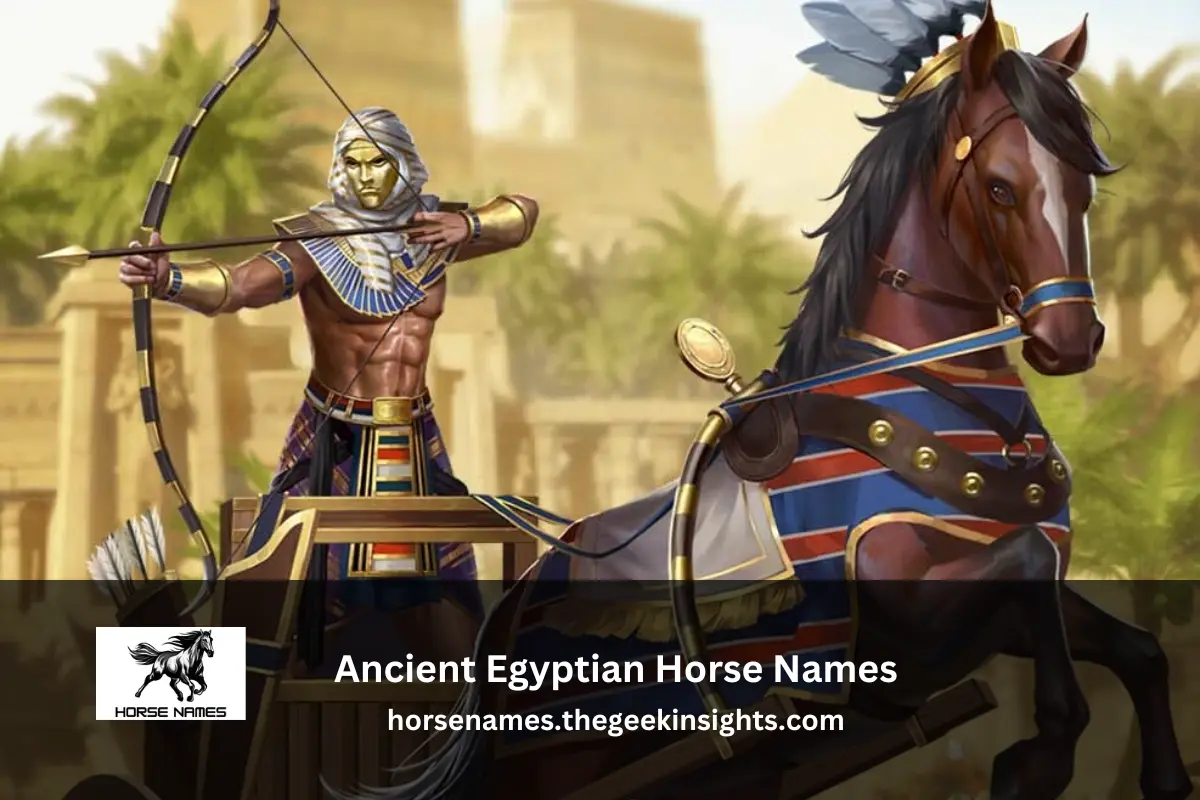
Ancient Egyptian Horse Names
Here’s a royal and magical list of Ancient Egyptian Horse Names, drawn from the language, mythology, royalty, and powerful symbolism of the Nile Valley culture. These names are ideal for horses with a noble heart, golden refinement, or desert-born stamina — ideally suited for breeds such as the Arabian, Barb, or Akhal-Teke.
Derived from ancient figures, pharaohs, holy beasts, and poetic hieroglyphs, these names capture the mystery, grandeur, and spiritual richness of one of the world’s most historic and powerful cultures. Whether your horse gives off divine aura, desert toughness, or royal bearing, these names capture the elegance and majesty of Ancient Egypt.
Lists below contains significant names taken from mythology, the natural world, virtues, and ancient Egyptian mythology — ideal for horses worthy of a name that sounds like a dynasty.
Royal & Noble Egyptian Horse Names
| Name | Meaning / Inspiration |
|---|---|
| Pharaoh | Ruler of ancient Egypt |
| Nefertari | “Beautiful companion” (queen) |
| Ramses | Powerful king / “Born of Ra” |
| Cleopatra | Iconic queen |
| Tutankhamun (Tut) | Boy king |
| Senet | Companion or beloved |
| Menes | Founder of the first dynasty |
| Hatshepsut | Female pharaoh / powerful ruler |
| Osorkon | Name of royal Libyan-Egyptian kings |
| Merit | Beloved or worthy |
Sun, Desert & Nature-Themed
| Name | Meaning / Inspiration |
|---|---|
| Sahara | Desert |
| Sharifa | Noble / desert princess (Arabic-rooted) |
| Thoth | Moon, wisdom, and writing deity |
| Papyrus | Plant used in ancient writing |
| Lotus | Sacred flower of rebirth |
Short & Catchy Names (Ancient Sounding)
| Name | Inspiration |
|---|---|
| Zahi | Bright / shining |
| Nemi | Sweet or gentle (feminine) |
| Asar | Ancient name for Osiris |
| Tiaa | Egyptian queen |
| Kiya | Wife of Akhenaten |
| Djet | Cobra symbol of kingship |
| Ahmose | “Born of the moon” |
| Kemet | Ancient name for Egypt |
| Amisi | Flower / gentle |
| Rami | Loving / elevated one |
Names Inspired by Pharaohs & Royalty
| Name | Meaning / Reference |
|---|---|
| Ramses | Famous pharaoh / “Born of Ra” |
| Cleopatra | Queen of the Nile |
| Nefertari | “Beautiful Companion” (Great Royal Wife) |
| Tutankhamun | “Living Image of Amun” (Boy King) |
| Hatshepsut | Powerful female pharaoh |
| Ankhesenamun | “Her life is of Amun” |
| Thutmose | “Born of Thoth” |
| Tiye | Queen consort of Amenhotep III |
| Khafre | Pharaoh who built the second pyramid |
Nature & Symbolic Egyptian Horse Names
| Name | Meaning / Inspiration |
|---|---|
| Kemet | “Black Land” (Ancient name for Egypt) |
| Nileah | Feminine twist on Nile River |
| Lotus | Sacred flower, symbol of rebirth |
| Scarab | Sacred beetle, symbol of protection |
| Desheret | “Red Land” – desert |
| Papyrus | Ancient writing plant |
| Ankh | Symbol of eternal life |
| Ka | Life force or soul |
| Sahara | “Desert” – vast and wild |
| Nefru | “Beauty” |
Elegant & Exotic Egyptian-Inspired Names
- Aseta – Variation on Isis (Aset in Egyptian)
- Zahra – “Flower” or “Radiance” (Arabic influence)
- Amunira – “Beloved of Amun”
- Kiya – Mysterious queen from Akhenaten’s court
- Sutekh – Alternate name for Set (chaos & storms)
- Maatka – “Truth of the soul”
- Nebet – “Lady” or “Mistress”
- ZepTepi – “The First Time” (mythical age of creation)
- Menna – Name found on many tombs, meaning “steadfast”
Stallions/Geldings:
Royal & Divine:
- Amenhotep – “Amun is satisfied”
- Thutmose – “Thoth is born”
- Ramesses – “Ra has fashioned him”
- Akhenaten – “beneficial to Aten”
- Tutankhamun – “living image of Amun”
- Sethos – “of Set”
- Khaemwaset – “appearing in Thebes”
- Menkheperre – “the soul of Ra endures”
Power & Strength:
- Khaemwaset – “appearing in power”
- Seneb – “healthy”
- Djeser – “sacred, holy”
- Nefer – “beautiful, good”
- Ankh – “life”
- Djed – “stability”
- Was – “power”
- Senebty – “healthy one”
Mares
- Nefertiti – “the beautiful one has come”
- Cleopatra – “glory of the father”
- Hatshepsut – “foremost of noble women”
- Nefertari – “beautiful companion”
- Ankhesenamun – “she lives for Amun”
- Merit – “beloved”
- Sitamun – “daughter of Amun”
- Tiye – ancient queen’s name
Beauty & Grace
- Nefret – “beautiful”
- Nebet – “lady, mistress”
- Ankhet – “she who lives”
- Merit – “beloved”
- Henut – “mistress”
- Sat – “daughter”
- Renpit – “year, fresh”
- Khenti – “foremost”
Nature & Element
- Sopdet – Sirius star
- Iabet – “east, left”
- Imentet – “west, right”
- Khepri – “morning sun”
- Atum – “complete one”
- Shu – “air, dryness”
Colors (Egyptian Style)
- Kem – “black”
- Hedj – “white”
- Desher – “red”
- Wadj – “green”
- Khenet – “yellow”
- Irtyru – “blue”
- Nebu – “gold”
- Tehen – “bright, shining”
Sacred Animals
- Bennu – sacred bird
- Apis – sacred bull
- Khepri – scarab beetle
- Ahti – sacred fish
- Mau – cat
- Taweret – hippo
- Sobek – crocodile
- Wepwawet – wolf
Hieroglyphic Concepts
- Ankh – “life”
- Djed – “stability”
- Was – “power”
- Tyet – “welfare”
- Shen – “encircle, protect”
- Nekhbet – “she of Nekheb”
- Wadjet – “green one”
- Uraeus – “rearing cobra”
Geographic/Cities
- Memphis – ancient capital
- Thebes – “Waset”
- Heliopolis – “Iunu”
- Dendera – “Iunet”
- Edfu – “Djeba”
- Kom Ombo – “Nubt”
- Philae – “Pilak”
- Aswan – “Swenet”
Unisex Names
- Khenti – “foremost”
- Nefer – “beautiful”
- Seneb – “healthy”
- Ankh – “life”
- Hotep – “peace”
- Dua – “worship”
- Meryt – “beloved”
- Sab – “star”
Mythical & Symbolic Names
- Sphinx (Mystical guardian)
- Aten (Solar disk, radiant like a golden horse)
- Nile (After the life-giving river)
- Khopesh (Egyptian sickle-shaped sword—sharp and strong)
- Scarab (Symbol of rebirth—great for a resilient horse)
- Obelisk (Tall and majestic)
Historical & Pharaoh-Inspired Names
- Ramses (Great warrior pharaoh)
- Nefertari (Beloved queen—elegant and noble)
- Tutankhamun (Tut) (The boy king—good for a young horse)
- Hatshepsut (Female pharaoh—strong and regal)
- Cleopatra (Iconic queen—glamorous and intelligent)
Desert & Nature-Inspired Names
- Sahara (Vast and free)
- Dune (Sandy and swift)
- Amunet (Hidden one, mysterious)
- Sirocco (Hot desert wind)
- Nubia (Ancient kingdom, exotic and strong)
Fun & Playful Names
- Papyrus (For a light, fast horse)
- Ankh (Symbol of life—great for a beloved horse)
- Pharaoh’s Chariot (Epic and royal)
- Mummy’s Curse (For a mischievous or stubborn horse)
- Desert Rose (Beautiful yet tough)
Names of Royalty & Virtue
These names reflect the pharaohs’ power, majesty, and the virtues admired in ancient Egypt.
- Male:
- Akhenaten (Эхнатон): “Effective for Aten.” A pharaoh known for religious reform.
- Amenhotep (Аменхотеп): “Amun is satisfied.” Name of several pharaohs.
- Huni (Хуни): An ancient pharaoh’s name.
- Khafra (Хафра): A pharaoh, builder of the second Great Pyramid.
- Menes (Менес): Legendary first pharaoh of unified Egypt.
- Ramesses (Рамзес): “Ra is the one who bore him.” Name of many powerful pharaohs. For a strong, mighty, and enduring horse.
- Thutmose (Тутмос): “Thoth is born.” Name of warrior pharaohs.
- Khufu (Хуфу): Pharaoh who built the Great Pyramid.
- Tutankhamun (Тутанхамун): “Living image of Amun.” For a precious and majestic horse.
- Uny (Уни): “The unique one.” For a distinctive horse.
- Female:
- Ankhesenamun (Анкесенамун): “She lives for Amun.” Queen, wife of Tutankhamun.
- Hatshepsut (Хатшепсут): “Foremost of Noble Ladies.” Powerful female pharaoh. For a strong, leading mare.
- Nefertari (Нефертари): “The most beautiful of them all.” Queen, wife of Ramesses II. For an exceptionally beautiful mare.
- Nefertiti (Нефертити): “The beautiful one has come.” Famous queen. For a stunning mare.
- Sobekneferu (Собекнеферу): Female pharaoh, name means “beauty of Sobek.”
- Tiy (Тий): Influential queen, mother of Akhenaten.
Names Reflecting Nature & Qualities
These names draw from the Egyptian landscape, precious elements, and desired horse characteristics.
- Male / Unisex:
- Nile (Нил): The lifeblood river of Egypt. For a flowing, vital, and powerful horse.
- Sahara (Сахара): The vast desert. For a resilient, enduring, or sandy-colored horse.
- Gold (Злото): Precious metal. For a cherished or golden-coated horse. (Ancient Egyptian word for gold was nbw or nebu)
- Lion (Лаб): Symbol of strength and royalty. (Ancient Egyptian word for lion was rw or ru)
- Falcon (Бхека): Symbol of speed and vision. (Ancient Egyptian word for falcon was bik)
- Pearl (Жемчуг): For a rare and precious horse.
- Onyx (Оникс): A dark gemstone. For a sleek, black horse.
- Ruby (Рубин): A precious red gem. For a reddish or prized horse.
- Swift: For a fast horse. (Can translate to words like pẖr meaning “to turn quickly”)
- Victory: For a winning horse. (Ancient Egyptian word for victory was nḫt or nekhet)
- Female:
- Lotus (Лотос): Sacred flower, symbolizing creation and rebirth. For a beautiful and pure mare.
- Jewel (Ювелир): For a precious and beautiful mare.
- Gazelle (Газель): For a graceful, swift, and elegant mare.
- Emerald (Изумруд): A precious green gem.
- Topaz (Топаз): A radiant gem.
Ancient Egyptian Horse breeds
In Ancient Egypt, horses were introduced relatively late in its long history — around 1700 BCE, likely during the Second Intermediate Period, through interactions with the Hyksos. While Ancient Egyptians did not have native horse breeds, they imported and bred horses that became vital for warfare, chariotry, and elite symbolism.
Here’s what’s known about horse types associated with Ancient Egypt:
Key Horse Types Linked to Ancient Egypt
1. Egyptian Chariot Horse
- Type: Likely early Oriental-type or proto-Arabian horses
- Use: Pulling light chariots for war, hunting, and ceremony
- Traits: Slim, long-legged, high-endurance, spirited
- Fun Fact: Horses were often richly decorated and buried with pharaohs or nobility.
2. Libyan Desert Horse
- Origin: From Libya and western desert regions
- Imported to Egypt during New Kingdom period
- Traits: Hardy, desert-adapted, light and agile
- Use: Supplementing Egyptian cavalry and royal stables
3. Nubian Horse (Kushite influence)
- From Nubia (south of Egypt), possibly smaller and rugged
- Used for ceremonial processions, tribute, and sometimes in war
- Connected to Kushite pharaohs who ruled Egypt during the 25th Dynasty
Did Ancient Egypt Have Breeds?
No formal “breeds” in the modern sense existed in Ancient Egypt. Horses were valued more by type, origin, and traits than by standardized breeding lines. However, horses were symbols of royalty, power, and divine favor, often named, decorated, and celebrated in hieroglyphics.
Cultural Importance
- Pharaohs like Thutmose III and Ramesses II were renowned horsemen.
- Chariots and horses were key to Egyptian military dominance in the New Kingdom.
1. Egyptian Chariot Horse
Elegant, swift, elite — used by pharaohs in warfare and ceremonies
- Nebet-Het – “Lady of the House,” another name for Nephthys
- Thutmose – After the warrior Pharaoh
- Khamet – “Egypt” in ancient tongue
- Eye of Horus – For strength, protection, and sight
- Bastet’s Grace – Nimble and revered
- Chariot of Light – Symbolic of divine warfare
2. Libyan Desert Horse
Desert-adapted, agile, enduring — often imported into Egypt
- Sand Whisperer
- Deshret – The red land/desert of Egypt
- Libu Wind – Refers to the ancient Libyan tribes
- Red Dune
- Aten Blaze – Named for the sun disc deity
- Sirocco – A desert wind
- Golden Mirage
- Nomad Spirit
3. Nubian Horse (Kushite Lineage)
Sturdy, symbolic, often used in ceremonies and by Kushite rulers
- Meroe Star – Named after the Nubian royal city
- Kandake’s Pride – “Kandake” = Nubian queen
- Kush Flame
- Ebony Thunder
- Nile Whisper
- Royal Nubia
- Gold of Ta-Seti – Ta-Seti was an early Nubian kingdom
- Desert Jewel
- Ruler’s Gift
- Horus of the South
Tips for Choosing an Ancient Egyptian Horse Name
- Consider their Personality: Does the name’s meaning align with your horse’s temperament (brave, calm, fiery, elegant)?
- Look at their Appearance: Does their coat color or markings suggest a specific deity or element (e.g., Ra for a golden horse, Set for a dark one)?
- Sound and Feel: Say the name aloud. Does it have the ancient, regal, or mystical resonance you’re seeking?
- Historical Context: If you have a specific interest (e.g., chariot warfare, specific pharaohs), you can delve deeper.
I hope this list helps you find a truly magnificent Ancient Egyptian name for your horse!